Changing Face of Las Vegas Entertainment
By Robert Macy
Dateline Las Vegas
Editor's Note: Robert Macy, an Associated Press
writer for 30 years, was Correspondent of the Las Vegas AP bureau during the city's dynamic
growth years, 1981-2000. He has covered the city entertainment scene,
from headliners like Sammy Davis Jr., George Burns and Barbra Streisand to
production shows that have evolved the past two decades. Now a nationally-syndicated
writer, he takes a look at changes in store for the
entertainment capital.
--------
LAS VEGAS --  n the early 1980s, late Sammy
Davis Jr. talked of the days when he earned $350 a week opening at the city's showrooms "and
was darned glad to get it."
n the early 1980s, late Sammy
Davis Jr. talked of the days when he earned $350 a week opening at the city's showrooms "and
was darned glad to get it."
Entertainers who then boasted of earning $350,000 a week
"should have been here in the old days," Davis lamented.
"The "good old days" -- when guests were
treated to free chuck wagon buffets and stars like Dean Martin and Jerry Lewis roamed the
casinos dealing cards and mingling with gamblers -- are long gone.
And Las Vegas is heading for more changes in a star policy
that has been cyclical since the early 1950s, when the Strip consisted of a handful
of hotels and stars such as Jimmy Durante, Rudy Vallee and Betty Hutton graced the stage.
Many resorts are spending tens of millions of dollars on
flashy production shows that must run for three to five years to recover their
initial cost. That means fewer showrooms featuring name
entertainers.
The city's top entertainment executives say their industry is
changing nationwide, and Las Vegas must change with it.
Two famous Las Vegas star venues closed in the summer of
2000,
leaving only four showrooms featuring a regular menu of headliners.
The Desert Inn, where the late Edgar Bergen
opened the showroom 50 years ago, closed to make way for a new resort complex
planned by gaming mogul Steve Wynn.
And Caesars Palace closed its famous Circus Maximus
showroom to
make way for new high-roller suites. It plans to develop a new
entertainment venue, but that project is "in the concept stage" and still 24
months away, according to Tom Pilkington, vice president of entertainment and special
events for the famous resort. Some type of temporary venue is to be
erected until a permanent facility is built.
That will leave only the MGM Grand's Hollywood Theater, the
Stardust
Hotel (where veteran entertainer Wayne Newton headlines much of the year),
the Orleans and the Las Vegas Hilton with celebrity showrooms.
"When you look at a star policy format, it is very
difficult to make it economically feasible," Pilkington, who has been with Caesars 22
years, said in a recent interview. "There was a day, from casino marketing
standpoint, where the celebrity in the showroom brought in gaming customers. Due
to the limited number of venues in the country, you didn't see Frank Sinatra or a
Sammy Davis Jr. or an Ann -Margret going out on a 60-city tour.
"Now you have every major and secondary market with
venues where every major recording star can perform. Now if you live in Houston or
Chicago or L.A., the performers you're going to see on the marquees in Vegas are the
same ones you'll see down the street in those cities."
Richard Sturm, president of MGM MIRAGE entertainment, has
been through several entertainment cycles in 27 years at the MGM Grand. Star
policies have changed dramatically in that period, he said.
"In 1973, celebrity performers were working engagements
of a month at a time, and would do two shows a night, seven days a week," Sturm
recounted. "Now it is highly unusual for celebrities to do more than one show a
night, with few exceptions, and certainly not work more than two weeks at a
time."
Over the years, hotels have switched to Broadway shows or
other productions when stars became too pricey, only to revert back when celebrities lowered their prices or the public tired of the stage shows.
Glenn Medas, vice president of entertainment for Mandalay
Resort Group, blames agents and managers for pricing stars out of the Las Vegas market.
"I think what happens is that there's a price for
everywhere else in the country (for stars) and then there's a price for Las Vegas," said
Medas. "I would say the agents and managers don't want to see the casinos
make money on the acts because they believe the casinos will make their money
by using the stars to draw gamblers."
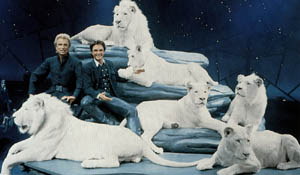
One of the most successful entertainment products in Las
Vegas, Sturm said, is the show that combines celebrities and a production extravaganza,
such as Siegfried & Roy.
Wynn, former chairman of Mirage resorts, pulled a coup when
he signed the famous illusionists to a 10-year, $57.5 million contract to open his
new Mirage hotel in early 1990. Some thought the unprecedented contract
a gamble, but time and the public have proven Wynn a prophet.
Siegfried & Roy, now in their 11th year at the Mirage, have grossed more than $1
billion, a world record for a production show.
There was also skepticism when Canadian-based Cirque du
Soleil began producing a show in a huge tent behind the Mirage in the early
1990s. The question was whether the Vegas visitor was ready for the avant-garde style
of entertainment.
Any doubts were erased with the unprecedented success of
Cirque's
"Mystere" at Treasure Island, which was launched in 1993.
When Mirage's $1.6 billion Bellagio Resort opened in 1998, a featured attraction was the new
Cirque production "O," a $92 million attraction that ranks with
Siegfried & Roy as the hottest tickets in town.
"The Cirque product is cutting edge, "Pilkington
said. "It's the entertainment material that people are clamoring for."
The downside of major production shows is the enormous
start-up costs; the upside is that you have three to five years to amortize those costs,
Pilkington said. Still, unless you have a "super, super
attraction," the visitor is going to see that show only once, he added.
Nightly sellouts of shows such as Siegfried & Roy,
"O" and "Mystere" are a tribute to the staying power of such shows, Strum said. "The
reason they have the staying power is that you can't see these types of shows in
any other city."
MGM Grand is the only resort that offers both a star room,
the Hollywood Theater featuring celebrities such as Tom Jones and David
Copperfield, and a production show, the $45 million extravaganza
"EFX," starring Tony award-winner Tommy Tune.
Although Las Vegas is experiencing a dearth of celebrity
showrooms, the opposite is true of major concert venues.
The 15,000-seat MGM Grand Garden Arena has attracted
megastars such as Barbra Streisand and Neil Diamond. The 12,000-seat Mandalay Bay
Events Center has drawn a wide range of talent including Bette Midler, Ricky
Martin and The Three Tenors. There's also the 19,000-seat Thomas & Mack
Center and the 7,000-seat Aladdin Theatre for the Performing Arts, which reopens in
mid-August after undergoing a $20 million renovation.
With 34 million visitors annually and 1.5 million local
residents, promoters are finding the major concert venues can sell out with the right
names on the marquee.
"No doubt about it, we're on every concert tour,"
Medas said.